
Why So Many Indian Employers Are Getting EWA Wrong
Nearly 42.5% of employees in India’s private sector report stress-related issues, yet most employers are still debating whether the tools to address it are safe, legal, or practical. Yet most businesses still haven’t addressed the one payday problem that directly fuels it.
The myths about earned wage access are costing businesses real money in attrition, absenteeism, and lost productivity. This article tackles the 10 most persistent misconceptions head-on. By the end, you’ll know exactly what EWA is, and what it isn’t, so you can make a genuinely informed decision for your workforce.
What Is Earned Wage Access? (Quick Primer Before the Myths)
Earned Wage Access (EWA) lets employees withdraw a portion of their already earned salary before the official payday. It is not a loan. It is not an advance from the employer. A third-party platform like Jify fronts the funds and recovers them automatically on the next payroll date. The employer’s payroll cycle stays completely unchanged. For a deeper look at how EWA works across different business sizes, see our guide to earned wage access for small businesses.
Myth 1 — Is Earned Wage Access Just Another Loan Product?
No, earned wage access is not a loan. Employees access money they have already earned, with no credit check, no interest accrual, and no debt obligation.
A loan involves borrowing money you haven’t yet earned and repaying it with interest over time. EWA does the opposite here. It releases wages already on the employer’s books, days before the standard payroll date. The Reserve Bank of India currently classifies EWA platforms differently from lending and NBFC products, precisely because no new credit is being extended.
A factory worker who has completed 18 days of a 30-day pay cycle has already earned roughly 60% of their monthly salary. EWA simply makes a portion of that available early, there is nothing to repay, because the money was already theirs.
Key distinction:
- Loan → borrowed capital + interest + credit risk
- EWA → earned wages + small platform fee + zero credit risk
Myth 2 — Does EWA Encourage Irresponsible Financial Behaviour?
The short answer is no. Research consistently shows that EWA reduces reliance on high-interest informal credit, not the reverse.
A 2023 Harvard Kennedy School study surveyed over 1,000 EWA users and found that avoiding high-cost short-term credit was the primary reason workers turned to earned wage access. In India specifically, informal borrowing (from family, employers, or local moneylenders) carries an implicit or explicit cost that compounds over time. EWA removes the trigger for those borrowing decisions.
The mechanism matters, employees using EWA are accessing their own money, not spending beyond their means. Behavioural data from Jify’s platform across 500+ Indian businesses shows that average EWA withdrawals represent just 28% of earned wages, well below the 40% platform cap.
Myth 3 — Is EWA Too Complicated for Indian SMEs to Implement?
Not at all. Modern EWA platforms integrate with leading HRMS systems in under 48 hours, with less than 2 hours of HR team involvement.
The assumption that EWA requires a dedicated IT project or complex payroll overhaul is outdated. Jify connects directly with your existing HRMS via API, no system switching required.
- Connect your HRMS to the Jify platform via API or CSV upload.
- Configure access rules- which employee grades can access EWA and at what cap.
- Communicate the benefit to employees via Jify’s pre-built onboarding kit.
Most Jify customers go live within one business day. HR teams report spending fewer than 2 hours on the initial setup, with near-zero ongoing administration.
Myth 4 — Will EWA Increase Payroll Processing Complexity?
No, it doesn’t. Employers pay normal payroll on the standard date. The EWA platform handles the early payment float entirely.
This is the myth that concerns CFOs most, and it is also the easiest to disprove. Here is what actually happens:
- Employee requests ₹5,000 via the Jify app mid-month.
- Jify releases ₹5,000 directly to the employee’s bank account from its own float.
- On payroll date, the employer pays the employee’s full gross salary as normal.
- Jify automatically recovers the ₹5,000 from the payroll disbursement.
The employer’s payroll team does nothing differently. There is no new line item to manage, no advance ledger to maintain, and no change to statutory deduction calculations. For IT MSMEs with complex variable pay structures, see our dedicated guide to EWA for IT MSMEs.
See This in Practice!
Jify eliminates payroll complexity while giving your employees on-demand access to earned wages. Book a free Jify demo, no commitment, no IT project required.
Myth 5 — Will Employees Exhaust Their Wages and Have Nothing Left at Month-End?
Not at all. EWA platforms use hard access caps, typically 40% of earned wages, combined with financial wellness nudges to prevent over-withdrawal.
Jify’s responsible usage guardrails include:
- 40% cap on earned wages accessible per cycle — never more
- Cooling-off periods that limit transaction frequency
- In-app financial wellness nudges triggered when withdrawal patterns suggest stress
- Employer-set controls that allow HR to customise caps by grade or department
In practice, less than 4% of Jify users reach their maximum cap in any given month. The system is designed so that employees always receive a meaningful salary on payday, by design, not by accident.
Myth 6 — Is EWA Only for Large Enterprises?
That’s not true, EWA is no longer an enterprise-only benefit. Indian platforms like Jify are purpose-built for SMEs, with no minimum headcount and no employer cost.
The enterprise-only assumption comes from the early days of EWA in Western markets, where most platforms were built for large corporates and priced SMEs out.
Indian-built platforms like Jify were designed from the ground up for the Indian SME market. There is no minimum headcount requirement, no enterprise software licence fee, and no per-employee setup cost to the employer.
Some of Jify’s fastest-growing customers are garment manufacturers in Tiruppur, IT services firms in Pune, and retail chains in Tier-2 cities, all with between 30 and 180 employees. EWA may be even more impactful for SMEs than large enterprises, because SMEs typically cannot afford the salary advances and emergency loan schemes that large corporates offer.
Myth 7 — Does EWA Negatively Affect Employee Saving Habits?
No. EWA users tend to save more, because they stop paying the hidden cost of short-term borrowing.
Consider what happens when an employee needs ₹8,000 before payday and does not have EWA access. Common alternatives include:
- Credit card cash advance: 2.5% to 3.5% per month interest
- Personal loan from an NBFC: 18% to 36% annualised rate
- Informal borrowing from family: relationship cost, not financial
EWA replaces all three with a flat platform fee of ₹50-₹100 per transaction. An employee who previously borrowed ₹8,000 on a credit card for 15 days would pay approximately ₹300 in interest.
The EWA equivalent costs ₹75. The ₹225 difference, compounded across 6-8 borrowing events per year, adds up to over ₹1,500 in direct savings, money that can stay in an employee’s savings account.
Myth 8 — Is EWA Regulated or Legally Compliant in India?
Yes, Jify operates under RBI-compliant payment system frameworks. EWA is legally distinct from unregulated payday lending.
India’s payday lending sector has faced regulatory scrutiny precisely because it issues high-interest credit products to vulnerable borrowers. EWA is categorically different. Because EWA disburses earned wages, not new credit and it falls outside the purview of the RBI’s lending regulations, Jify operates with full data protection compliance under India’s IT Act.
Employers concerned about compliance risk should note: deploying an RBI-compliant EWA platform carries significantly less regulatory exposure than allowing informal salary advances, which create undocumented loan relationships on the company’s books.
Myth 9 — Do Only Low-Income Workers Benefit from EWA?
Absolutely not. Financial stress affects every salary band. Mid-level professionals earning ₹40,000 to ₹80,000 per month are among the heaviest EWA users in urban India.
The assumption that EWA is for “blue-collar workers only” ignores the urban cost-of-living reality. A software engineer earning ₹65,000 per month in Bengaluru or Mumbai typically carries EMI obligations, rent, and school fees that together consume 70-80% of take-home pay. An unexpected medical bill, vehicle repair, or flight home can create the same mid-month cash crunch faced by any worker.
Jify’s usage data shows that employees in the ₹40,000-₹80,000 monthly salary range account for 41% of all EWA transactions. And comparable to the share from employees earning under ₹25,000. EWA is a financial wellness benefit for the entire workforce, not a poverty intervention. For self-employed professionals, see our guide to EWA for freelancers.
Myth 10 — Does EWA Have Hidden Fees That Cost More Than a Bank Loan?
The simple answer is- no. EWA fees are transparent and substantially lower than any comparable short-term credit product available in India.
A direct cost comparison for accessing ₹20,000 for 15 days:
| Product | EWA Fees | Personal Loan EMI |
|---|---|---|
| Jify EWA | ₹75–₹100 flat fee | ~1.8–2.4% effective APR |
| Credit card cash advance | ₹500–₹700 interest | 36–42% p.a. |
| Personal loan (NBFC) | ₹600–₹800 interest + processing | 18–24% p.a. |
| Informal moneylender | ₹1,000–₹2,000 | 60–120% p.a. |
Jify discloses the transaction fee before every withdrawal, the employee sees exactly what they will pay before confirming. There are no subscription fees, no late fees, and no hidden charges. The employer pays nothing.
The Bottom Line: What EWA Actually Is (and Isn’t)
| EWA is | EWA is not |
|---|---|
| Access to already-earned wages | A loan or credit product |
| Employer-neutral (no payroll change) | A payroll advance or salary loan |
| Regulated under payment system law | An unregulated payday lender |
| Available to SMEs from day one | Enterprise-only software |
| A flat-fee, fully transparent product | A product with hidden interest |
| A financial wellness benefit for all staff | A benefit only for low-income workers |
| Recoverable automatically on payday | A liability on the employer’s books |
Conclusion: Ready to Move Past the Myths?
The ten myths covered above share a common root, i.e, EWA is new to India, and unfamiliarity breeds caution. That caution is understandable, but it is costing businesses and employees real money.
EWA is not a loan, not a compliance risk, not an IT project, and not a benefit only for large enterprises. It is a regulated, employer-neutral financial wellness tool that can reduce attrition, improve productivity, and give your workforce genuine financial resilience.
Over 500 Indian businesses have already seen the results.
See how Jify works – no commitment required. Get in touch with us and have Jify set up for your business for free.
Frequently Asked Questions About EWA Myths
1. Is earned wage access the same as a payday loan?
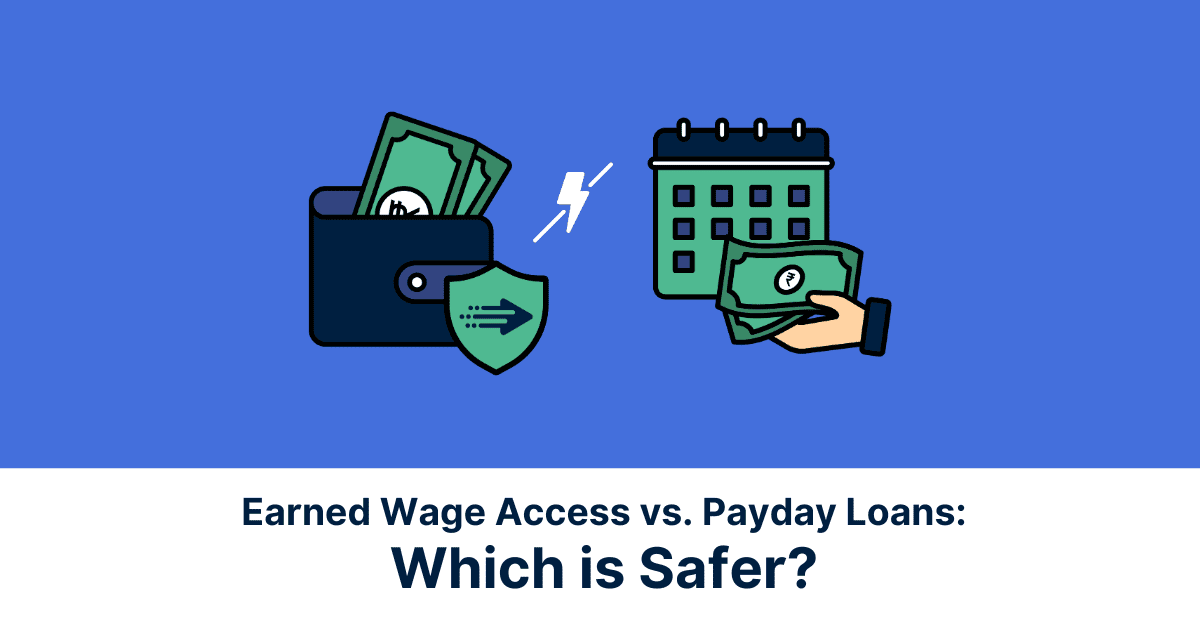
No. Payday loans are credit products with high interest rates, often 24–48% annualised in India. EWA lets workers access money they have already earned, there is no loan, no interest charged, and no debt created. The key difference is that EWA disburses existing earned wages; a payday loan creates new debt against future income.
2. Does EWA increase the risk of employees overspending?
No. EWA platforms like Jify set hard access limits, typically 40% of earned wages per cycle, and include in-app financial wellness nudges to promote responsible usage. Usage data from 500+ Indian businesses shows that the average employee withdraws less than 30% of earned wages, well below the maximum cap.
3. Is EWA legally approved in India?
Yes. EWA operates under existing RBI payment system guidelines and is not classified as a lending product. EWA is legally distinct from payday lending and NBFC credit products, which require separate RBI authorisations.
4. Is EWA suitable for small businesses in India?
Yes. Jify was designed specifically for Indian SMEs, with no minimum headcount requirement, no employer cost, and an integration time of under 48 hours. Companies with as few as 20 employees are active Jify customers across sectors, including retail, manufacturing, and IT services.
5. Will adopting EWA change my payroll process?
No. Employers continue paying salaries on the regular payday through their existing payroll system. Jify handles the early payment float, fronting the cash when an employee requests it and recovering it automatically on payroll date. There is no change to payroll software, bank mandates, or statutory deduction calculations.
6. What does EWA actually cost employees?
EWA providing companies usually charge a flat fee of ₹50–₹100 per transaction, disclosed before every withdrawal. There is no interest, no subscription fee, and no penalty for not using the service. The employer pays nothing. By comparison, accessing the same amount via a credit card cash advance typically costs 5–10 times more.
*Disclaimer:
The information contained herein is not intended to be a source of advice concerning the material presented, and the information contained in this article does not constitute investment advice. The ideas presented in the article should not be used without first assessing your financial situation or without consulting a financial professional.